Crypto gave humans keys.
Atlas gives agents bounds —
enforced at the substrate, not interpreted at runtime.
Agents stay in bounds. Spend caps, allowlists, time windows, MCC categories — all evaluated before settlement.
Policies signed once. Agents present them at execution. No runtime guardrails to talk past.
Every action and refusal lives on Base Sepolia. Third-party verifiable. The bound IS the audit.
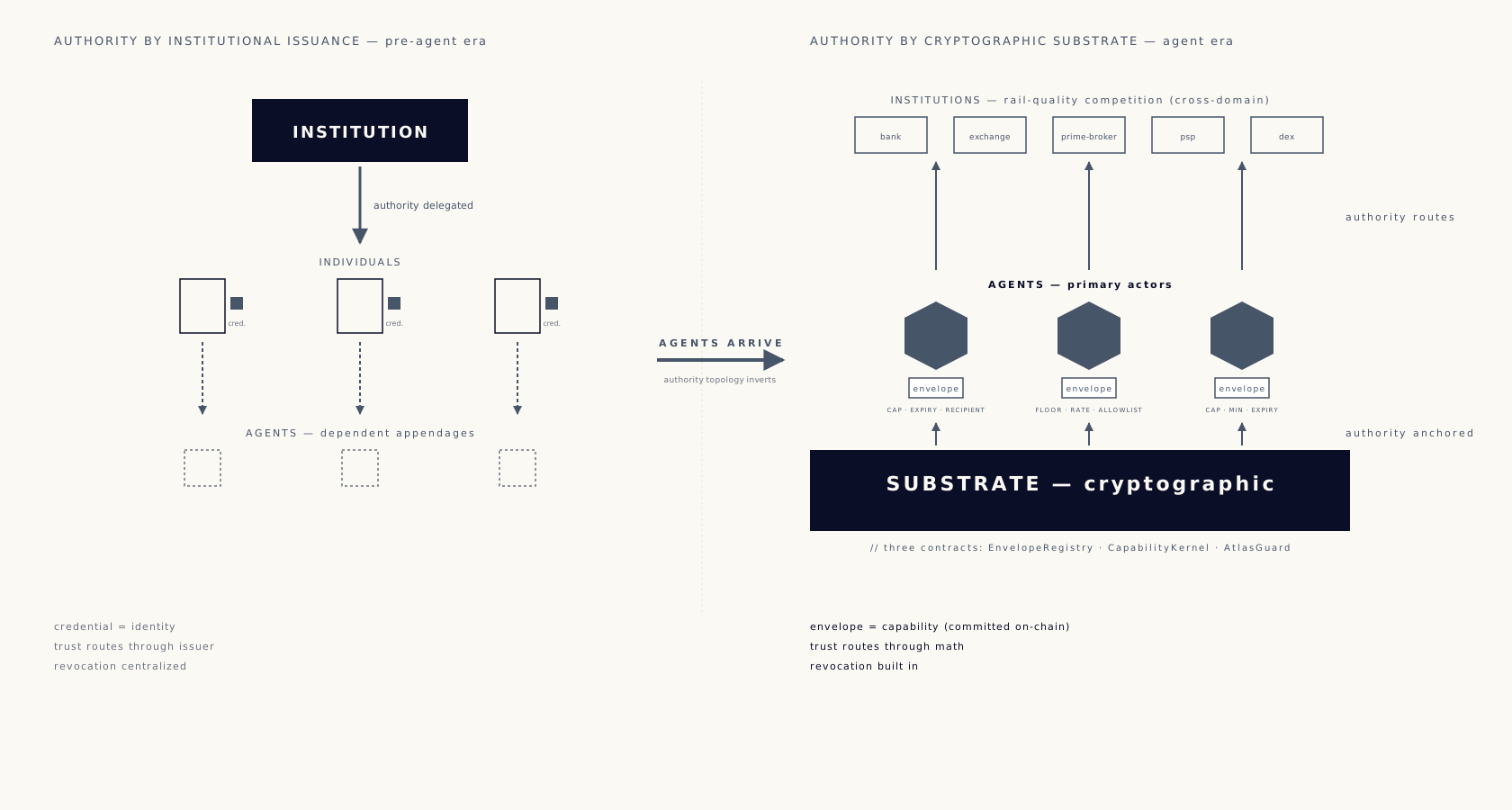
For thirty years, authority on the internet has flowed downward. An institution issues a credential. An individual presents it. A system trusts the institution. This worked because the principal — the human — could consent, recognize edge cases, and be present when the action happened. An autonomous agent has none of those properties.
As agents move from generating outputs to taking actions — sending value, signing contracts, executing trades — the authority assumption underneath the entire stack quietly stops holding.
When the principal is an agent rather than a human, authority cannot be granted by an institution and presented by the actor. It has to be constructed — at the cryptographic layer that binds the action itself.
The direction of authority changes. In the human era, authority flowed from the institution to the individual through the credential. In the agent era, authority must originate at the cryptographic primitive that binds action — because that is the only place an agent's authority can be anchored.
The same conclusion is emerging from formal methods, standards work, and production systems: agents do not need broader accounts; they need enforceable bounds. Agentic AI is the first technology that makes the institution-account paradigm visibly contingent.
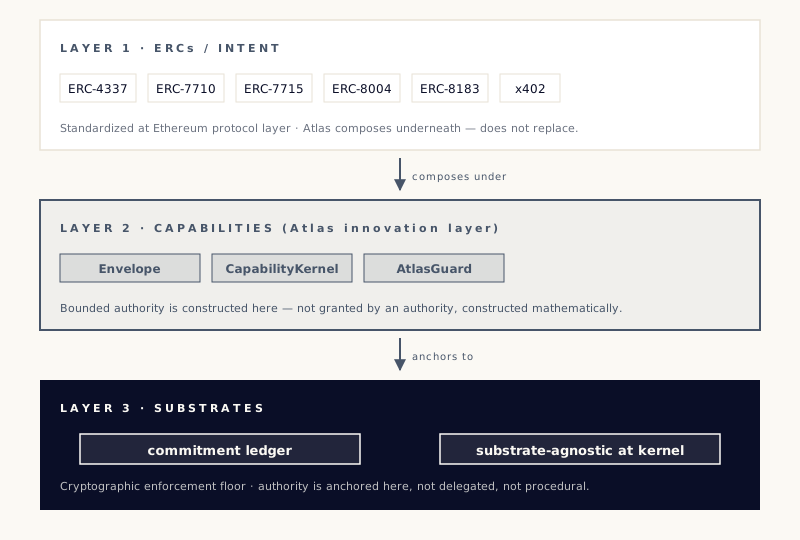
Three composable primitives. Nothing more than what enforcement requires.
Agents stay in bounds. Enforced at the substrate, not the wallet, not the app.
Every authorized agent action passes through a single on-chain gate that evaluates a composable set of policy predicates — amount caps, recipient allowlists, settlement windows, balance floors, rate limits. The action either satisfies the policy or does not exist on-chain.
Policies are signed once. Agents present them at execution time.
Principals commit policies in advance — cryptographically signed, replay-protected per chain and per principal. Agents present committed envelopes at execution time. The ledger is the source of truth for what is allowed.
Every action becomes a verifiable receipt.
Every successful execution emits a receipt that rolls into a verifiable hash chain. Institutions prove compliance against arbitrary public predicates without revealing the underlying flow.
Atlas runs alongside the standards that already define agent identity, delegation, payment, and execution. The substrate is not a replacement for the ecosystem — it is the cryptographic layer below it, where authority is anchored and enforcement happens.
Three patterns the substrate enables today — each one a category of failure the current agent stack cannot architecturally prevent.
The pattern. Coding agents (in IDEs, in CI, in production-touching workflows) operate with the credentials of the developer who launched them. Recent industry incidents have repeatedly demonstrated the category-level failure mode: an agent acting on natural-language instructions damages production state in ways that satisfy the literal instruction but violate operator intent.
What changes. The agent's authority is committed cryptographically before the session begins — which repositories it can read, which environments it can deploy to, which command classes it can execute, time-windowed. Destructive actions outside the envelope cannot execute. The agent can be convinced to attempt anything; only actions satisfying the policy go through.
The pattern. Treasury teams write policy on paper — per-action caps, counterparty allowlists, settlement windows, balance floors, AML rate limits. The agent is expected to respect the policy, but enforcement lives in middleware that the agent might or might not honor under adversarial conditions.
What changes. The compliance team commits the policy as a cryptographic envelope — once. The agent operates within it for the policy lifetime. Every transfer either satisfies all predicates or does not exist on-chain. The audit chain records the exact receipt of what executed.
The pattern. A primary agent delegates a sub-task to a specialized sub-agent. Today, this means handing over credentials — the sub-agent inherits the parent's full authority, and a buggy or compromised sub-agent multiplies blast radius across the system.
What changes. The parent issues a derived envelope to the sub-agent — strictly weaker than its own. The sub-agent's authority is a verifiable subset of the parent's. Composition becomes safe by construction: sub-agents cannot escalate, and the delegation chain is auditable end-to-end.
The agentic economy needs an authority layer that does not assume a human principal. The infrastructure that exists today was built for one; agents need the other. Bounded-authority substrate is the architectural primitive between intent and settlement — the layer where the next decade of agent-native commerce gets anchored, audited, and composed.
The thesis is supported empirically, formally, and structurally.
If you are evaluating agent-authorization infrastructure, designing institutional policies for autonomous agents, or thinking about how the substrate of the agentic economy gets built — we'd like to talk.
Build with us.
The agent can be wrong. The bound stays right.