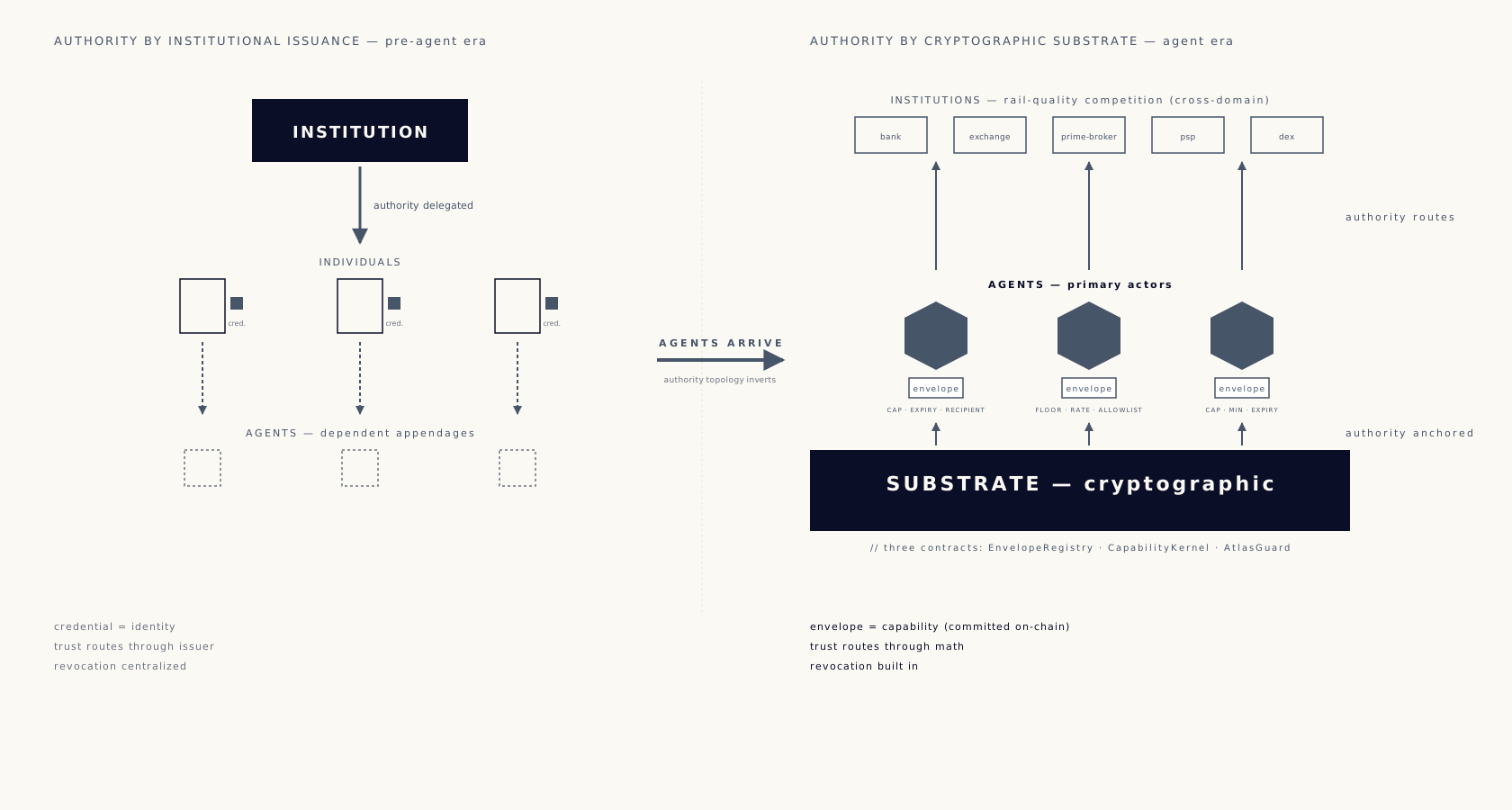
why authority moves to the substrate when agents become primary actors
Crypto gave humans keys. Atlas gives agents bounds — bounded mathematically, because agents cannot supply judgment at execution time.
For thirty years, authority on the internet has flowed downward.
An institution issues a credential.
An individual presents it.
A system trusts the institution.
This architecture — OAuth, bearer tokens, identity providers, certificate authorities — assumed a principal that could carry it. A human.
Humans have consent, judgment, and presence. We can refuse. We can recognize edge cases. We are usually there when the action happens.
Those properties were load-bearing. Autonomous agents remove them.
OAuth answers the question: who is allowed to access this?
Agentic systems ask a different question: what exactly may this software do, under what constraints, and can those constraints be enforced without trusting the software?
That is not an OAuth problem.
It is a commitment problem.
An autonomous agent does not need broad delegated access to an account.
It needs bounded authority over a specific class of actions.
A treasury agent should not be able to "use the company wallet." It should be able to pay approved counterparties, up to a defined amount, during a defined settlement window, while preserving a defined reserve balance, only when a proof satisfies policy.
Anything outside that boundary should not be a violation to detect later. It should be an action that cannot be formed.
That distinction is the entire shift.
OAuth and bearer-token systems were designed around access. Once access is granted, the enforcement problem moves upward into applications, monitoring, policy engines, logs, reviews, alerts, and human escalation.
But agents operate at machine speed. They compose actions across systems. They do not pause at the same boundaries humans do. They do not notice institutional context unless it has been encoded. They do not supply judgment at execution time.
So the primitive has to change.
The question is no longer whether an agent is authorized to enter the room.
The question is whether the action itself carries a cryptographic commitment to its own limits.
An agent does not naturally respect institutional structure. It has no patience for friction it does not understand. And critically, it can carry cryptographic state itself, which humans historically could not.
These observations sound philosophical. They are architectural.
An agent can inherit authorization, but it cannot supply human presence at execution time. A bearer token can prove possession. It cannot prove judgment.
If the user is expected to notice when something is wrong, there is no longer a reliable backstop. The user is not making the action. Software is.
If the human is assumed to be "in the loop," the loop may already have closed when the agent was deployed.
OAuth was not just a protocol. It was a trust topology: institutions at the top, individuals in the middle, tokens flowing down.
Strip the middle layer of contemporaneous judgment and the topology has nothing left to anchor against.
The tokens flow into a void.
This is no longer theoretical. A Grok-linked Bankrbot incident — a tweet-driven agent paymaster — reportedly moved roughly six figures after a Morse-code prompt injection. A Windsurf zero-click MCP vulnerability showed how rendered content could rewrite local tool configuration and reach execution. OpenClaw research has documented prompt-injection persistence, tool hijack, and control-plane weakness. Different surfaces, same architectural root cause: agents acting under inherited authorization without bounded constraints on the action itself.
This is not a problem you patch by improving OAuth. It is a problem you solve by abandoning the assumption underneath OAuth: that authority should be represented primarily as delegated access to an account.
The OAuth critique is not that the credential is wrong. It is that the account is wrong — for autonomous agents. Account abstraction makes accounts more programmable; it does not make actions more bounded. The old question is which account the agent can use. The new question is what action the agent is allowed to form.
Agents do not need broader accounts. They need bounded action.
Accounts were the right primitive when principals were human. They are the wrong primitive for autonomous agents.
Institutions do not become irrelevant. The direction of authority changes.
In the human era, authority flowed from the institution to the individual through the credential.
In the agent era, authority must originate at the cryptographic primitive that binds action — because that is the only place an agent's authority can be anchored without relying on its judgment.
Crypto completed the first half of this inversion. Self-sovereign wallets gave individuals cryptographic authority that no institution issued. But the bind still stopped at the key. Wallet signatures are the Web3 form of bearer tokens: proof of possession, not proof of judgment. The agent era requires the second half of the inversion — moving authority from the credential to the action.
The institution does not disappear. It becomes one rail among others.
It competes on execution quality, compliance surface, settlement reliability, liquidity, latency, and cost — not on the exclusive right of issuance.
Agentic AI is the first technology that makes the institution-account paradigm visibly contingent. Until now, "credentials issued by an authority" felt like a law of nature. It was always a design choice, but the choice was invisible because no other principal existed at internet scale.
Agents make the choice visible.
Once visible, the architecturally correct choice becomes clear: authority should bind to the action itself.
The substrate alternative pushes the binding downward.
Below the wallet.
Below the account.
Below the application.
Into a layer where authority is not granted by a counterparty but constructed mathematically.
We call this the substrate.
An Atlas envelope is the smallest unit of bounded authority.
It pins, cryptographically, what an agent may do:
Not as advice.
Not as policy for later review.
As predicate.
The action either satisfies the envelope or does not exist on-chain.
This sounds restrictive. It is the opposite.
An institution that piles on rules — daily caps, sanctions allowlists, ISDA bilateral pinning, treasury floors, blackout windows, AML reporting thresholds — finds that substrate enforcement gets cleaner as policy gets richer, because each new predicate is enforced, not evaluated.
The same enrichment that would degrade a runtime-evaluation system strengthens a substrate system.
Complexity moves out of institutional trust and into verifiable constraint.
The measurement supporting this is on /evidence. The architectural details are on /architecture.
The bounded-authority frame is no longer one team's hypothesis.
The diagnosis has been reached independently from at least three methodological positions.
From the formal side — recent academic work establishes noninterference results for LLM-primitive programs at the language-calculus tier. Atlas's construction is the parallel result at the ledger-architecture tier.
From the standards side — OAuth's own lineage has begun to confront the agent-principal problem directly. Successor proposals and parallel agent-authorization efforts are emerging because delegated access does not fully answer bounded autonomous action.
From the production side — independent deployments are already operating against the same architectural pattern, validating that bounded authority works under live load.
Others diagnosed the gap. We closed it.
If the architecture is irreversible and the diagnosis is converging, then the question that remains is who builds the substrate.
Crypto gave humans keys. Atlas gives agents bounds.
The agent can be wrong. The bound stays right.